How well does a hearing aid help you follow a conversation? What changes when the room gets noisy, or when the device is carefully adjusted? We test hearing aids in a controlled laboratory to make those differences easier to compare before you buy or try a device.
Our process has three parts: fit the hearing aids to a defined hearing loss, record them in repeatable listening situations, and analyze the results. This page explains the process in plain language. Our full methodology documents the equipment, procedures, scoring calculations, and research behind it.
A controlled lab with realistic sound
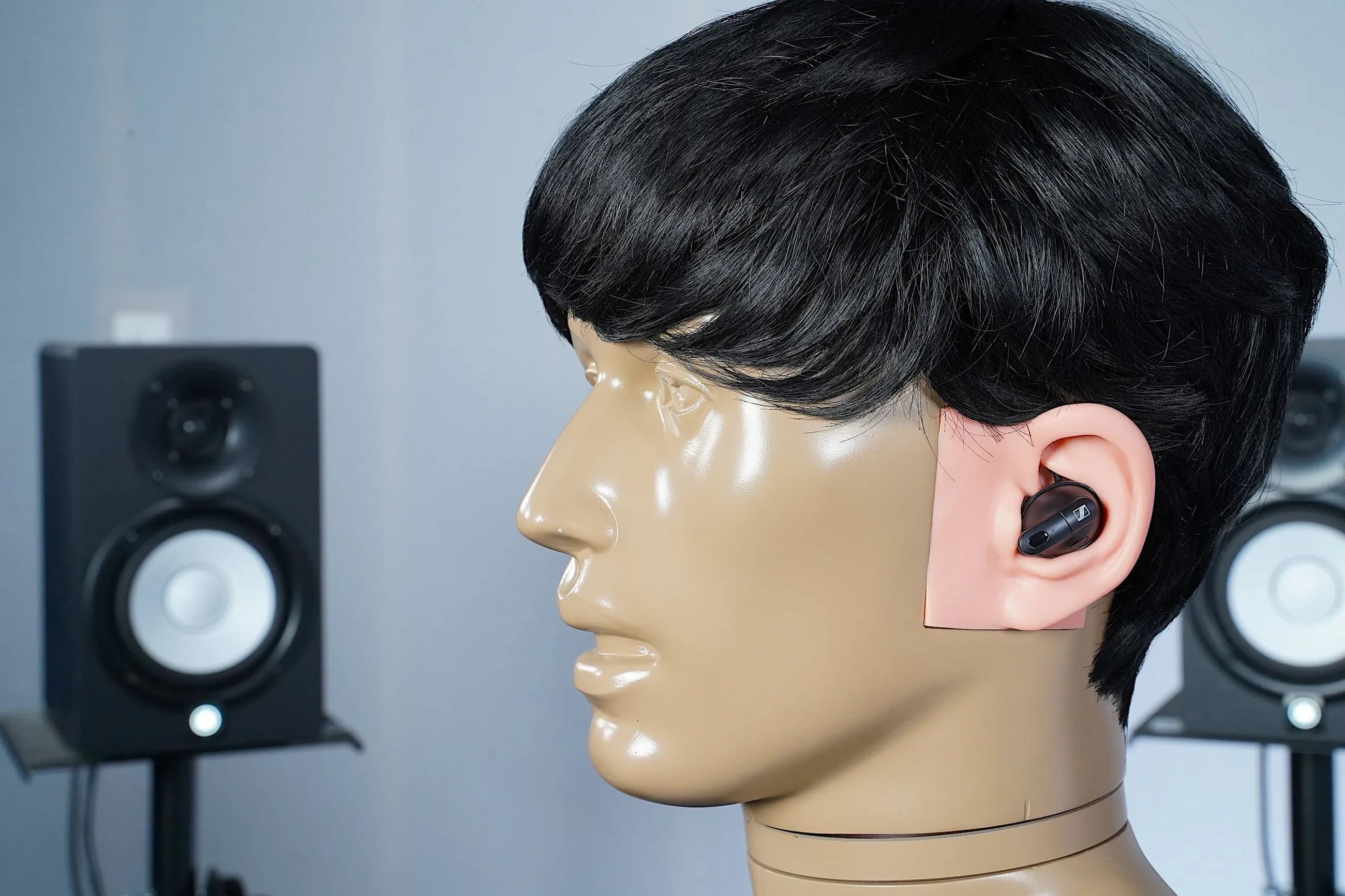
At the center of our laboratory is KEMAR, an acoustic manikin with artificial ears and microphones that measure sound where the eardrums would be. A ring of eight speakers surrounds the manikin, letting us recreate conversations and background sounds arriving from different directions.
The room is quiet and treated to reduce reflections. We calibrate the speakers and sound levels so devices face the same conditions. This lets us compare what each hearing aid delivers to the ears without the test environment changing from one product to the next. See our laboratory setup for the technical details.
Two fittings for each hearing aid
Hearing aid performance depends on the settings and the fit in the ear. We use a standard, sloping moderate hearing loss called N3 as a common starting point for both prescription and over-the-counter devices. Each hearing aid is evaluated in two configurations:
- Initial fit: We approximate what someone would experience by following the device’s basic fitting instructions. Depending on the product, that can mean entering a hearing test, completing an app-based test, or choosing the available settings that best match the target hearing loss.
- Tuned fit: We make a more thorough adjustment, using the available controls and ear tips to bring amplification closer to established prescription targets for soft, conversational, and loud speech. We check the sound at the manikin’s eardrum microphones, using an approach similar to real-ear measurements in a clinic.
Comparing the two helps show how much a device’s performance changes with fitting. The Tuned result describes what we achieved with that device and its available adjustments. Our device settings procedures explain the hearing loss, targets, ear-tip choices, and noise-processing settings.
Recording 72 listening scenes
For each fit, we record the hearing aids across 72 acoustic scenes: 12 background environments, conversations with one, two, or three talkers, and two variations of the actors. Talkers can be in front of the listener or off to either side.
The background recordings reproduce real environments at their documented sound levels. Each scene begins with at least 15 seconds of background sound before speech starts, giving the hearing aid time to adapt. Recordings from both ears capture the result.
We also make separate recordings for music streaming and feedback testing. The recording procedures explain how we build the scenes, check the fit and acoustic seal, and prepare files for headphone listening.
What we measure
We summarize sound performance in five areas. Some scores come from acoustic measurements and predictive models; feedback recordings are rated by trained listeners in blind tests.
- Speech in quiet and moderate environments: We estimate how much the hearing aid improves speech understanding compared with listening without it.
- Speech in noisy environments: We evaluate that benefit separately in louder backgrounds, where following a conversation can be more difficult.
- Own-voice naturalness: We estimate occlusion—the blocked-ear effect that can make your own voice sound boomy. The procedure focuses on the acoustic seal, with a separate approach for devices that actively cancel occlusion. It does not capture every aspect of how your voice will sound. Read about occlusion testing.
- Feedback handling: We record what happens when hands move near the hearing aids and cup the ears. Trained listeners rate the amount of audible squealing without knowing which device they are hearing. Read about feedback testing.
- Music streaming quality: We stream five genres of music from a phone and compare the ear recordings with the original audio using a hearing-science model. This metric measures changes in tonal balance; it does not capture every kind of distortion or streaming artifact. Read about music streaming testing.
Our current speech scores combine two equally weighted estimates: a research model of speech intelligibility called HASPIv2 and a model trained on more than 100,000 blind ratings from hearing aid consumers. The second model predicts how easy listeners would find the speech to understand. These are predictions from the recordings, rather than a direct hearing test on each shopper. Our speech scoring methods explain both components.
How the results become a SoundScore
We combine the five performance areas into a score for each fit. The weights come from surveys of hearing aid consumers and hearing care professionals, with speech understanding carrying the most weight.
The overall SoundScore then combines the Initial and Tuned results: 77% comes from the Initial fit and 23% from the Tuned fit. This weighting reflects survey responses about the importance of good sound with minimal fitting effort.
A fixed 1.1-point offset places the results in a more familiar rating range without changing their order or the differences between products. Scores are not capped at 5.0. We display the result to one decimal place; a displayed SoundScore of 4.0 or higher earns an Expert Choice award. The SoundScore methodology sets out the weights, calculation, and award threshold.
Listen to the differences yourself
Our product pages include laboratory recordings so you can compare how devices handle the same listening situations. Where both are available, switching between Initial and Tuned recordings lets you hear the effect of fitting adjustments alongside the scores.
The recordings are prepared for headphone listening, including equalization to account for the manikin’s acoustic characteristics. They demonstrate differences captured in our lab. Your headphones, playback level, and hearing will also shape what you hear.
What the results mean for you
A laboratory comparison gives every device a common test, but it cannot represent every person. Results describe the units, versions, ear tips, settings, hearing loss, and environments we tested. A device that performs well for our standard hearing loss may perform differently for yours.
Use the scores and recordings to narrow your options and inform a conversation with a hearing care professional. They do not replace an individual fitting or a trial in your own daily life. Scores can also change when methods are revised or existing recordings are reanalyzed; a recalculated score does not necessarily mean we physically retested a device.
For the complete procedures and supporting research, explore our hearing-device methods. Earplugs use a separate evaluation described in our earplug methods. Our Ethics Statement covers funding, editorial independence, disclosures, and corrections.