Choice
Lucid Ultra 128 Expert Review
HearAdvisor conducted independent laboratory testing on the Lucid Ultra 128 behind-the-ear hearing aid. This review presents our measured performance data across speech clarity, feedback control, own-voice comfort, and streaming quality.

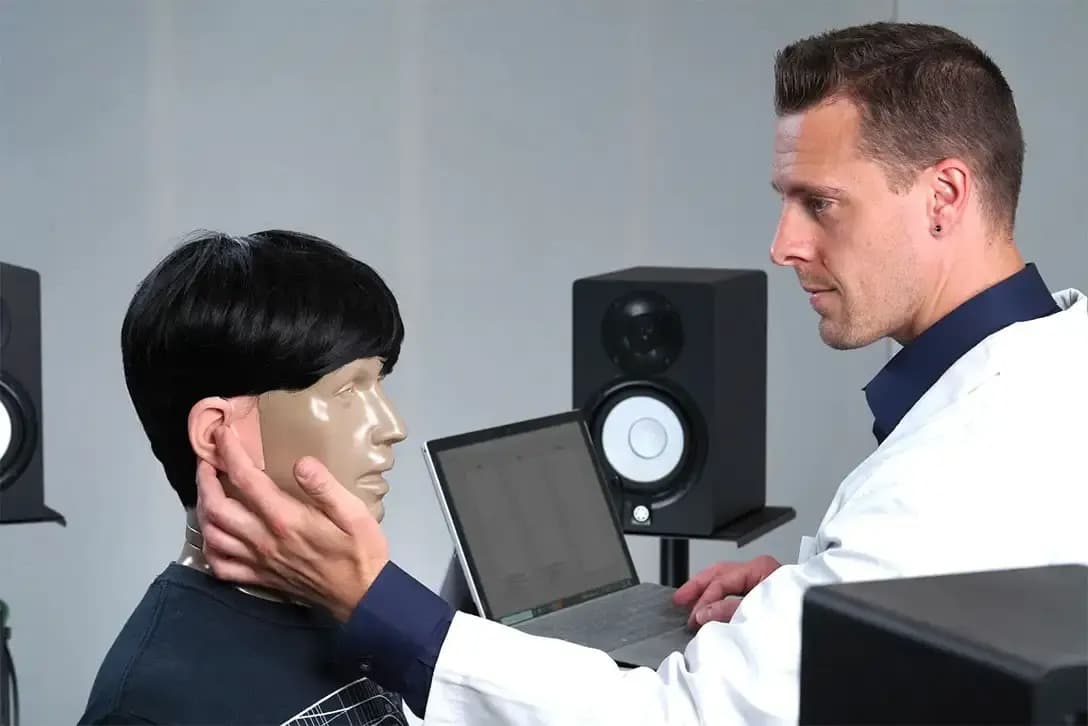
Quality data starts with quality recordings. HearAdvisor worked with GRAS to build a no-compromise front end so every test is repeatable and reliable.

Lab Assessment
Our Verdict on the Lucid Ultra 128
The verdict below synthesizes our laboratory findings for this premium prescription hearing aid. It weighs the measured strengths in speech performance against limitations we observed in feedback handling and streaming.
The Lucid Ultra 128 is a premium prescription BTE hearing aid with excellent speech clarity in quiet environments, best suited for users prioritizing conversation quality.
- Excellent speech in quiet4.4/5
- Above-average speech in noise for category+0.95
- Streams to both iPhone and Android
- Poor feedback handling1.7/5, -3.01 vs category
- Below-average music streaming quality
- Premium price point at $5,000
Fit Conditions
Lucid Ultra 128 Test Configuration Summary
We evaluated the Lucid Ultra 128 in both Initial and Tuned fit conditions. The summary below documents how each configuration performed across our standardized measurement protocol.
In initial fit testing with a closed vented dome and standard receiver, the Lucid Ultra 128 achieved a normalized score of 4.2/5. Speech in quiet measured 3.9/5, with speech in noise at 1.7/5. Notably, feedback handling was excellent at 5.0/5 in this configuration. Own-voice comfort scored 2.9/5 and music streaming 2.5/5. The initial fit represents strong out-of-box performance, particularly in feedback stability, making it accessible for users before professional optimization.
What is HearAdvisor's Initial Fit?
The Initial Fit approximates the most likely settings and eartips for a typical moderate hearing loss. Results are measured across the same 72 acoustic scenes in our custom-built lab, then scored on a 5-star scale using an auditory model.
Performance Metrics
Lucid Ultra 128 Score Breakdown
Our lab measures five distinct performance dimensions for every hearing aid we test. The card below displays how the Lucid Ultra 128 scored on speech in quiet, speech in noise, own-voice comfort, feedback control, and music streaming.
Choice
Amplification Data
Lucid Ultra 128 Insertion Gain Measurements
Real-ear insertion gain reveals how closely a hearing aid matches prescribed amplification targets across frequencies. The graph below plots the Lucid Ultra 128's measured output against the fitting prescription.
Audio Samples
Lucid Ultra 128 Processed Sound Recordings
We capture audio through a standardized manikin wearing each tested device. The recordings below let you compare how the Lucid Ultra 128 processes sound against an unaided reference signal.

Test Documentation
Lucid Ultra 128 Laboratory Test Notes
Our technicians document the specific settings and conditions used during each evaluation. The notes below detail the test configuration for this Lucid Ultra 128 assessment.
Initial Fitting | Tuned Fitting | |
|---|---|---|
| Ear Coupling | Closed Vented Dome | Closed Vented Dome |
| Receiver | Standard | Standard |
| Fitting Formula | Proprietary manufacturer default | Proprietary manufacturer default |
| Listening Program | Lucid (Automatic) | Lucid (Automatic) |
| Volume Setting | 54% (Default 7/13) | 54% (Default 7/13) |
| Software Version | BT Firmware v12.0.29, Firmware v9.2.33 | BT Firmware v12.0.29, Firmware v9.2.33 |
| Tuning Adjustments | Programmed to N3 audiogram by Lucid team, Other settings at manufacturer default | Programmed to N3 audiogram by Lucid team, LucidShape adjusted to match NAL-NL2 targets at 65 dB SPL, Other settings at manufacturer default |
| Notes | Default programming was performed by Lucid team, further adjustments were limited as we did not have access to their proprietary software. | Default programming was performed by Lucid team, further adjustments were limited as we did not have access to their proprietary software. |