AI Hearing Aid Showdown

Battle of the AI Hearing Aids

Four flagship hearing aids, each built around deep neural network (DNN) noise reduction, face off in a blind listening test. Same noisy scenes, same lab, hidden good and bad anchors. Your ears pick the winner.

Loading the battle...

The Lineup

Meet the Contenders

Every entrant runs its noise reduction on an on-device neural network. The approaches differ, and so do the results. A contender joins the blind test the moment its lab recordings are finished.

Signia

Signia Pure Charge&Go MaX

Recording in the lab

Multi-adaptive Xperience (MaX) platform, launched August 2026, runs four task-specific deep neural networks at once: one each for speech, the wearer's own voice, the surrounding scene, and noise.

Four DNNs share the job. Signia says the MaX chip has 54× the processing power of its predecessor so the networks can stay on all day.
Fortell

Fortell AI Hearing Aids

In the ring

Spatial AI: a deep neural network on a dedicated machine-learning coprocessor uses timing, level, and spatial cues from four microphones across the pair to pull speech away from competing voices and noise.

Direct speech enhancement. The AI 2.0 update retrained the network on a much larger library of real-world sound.

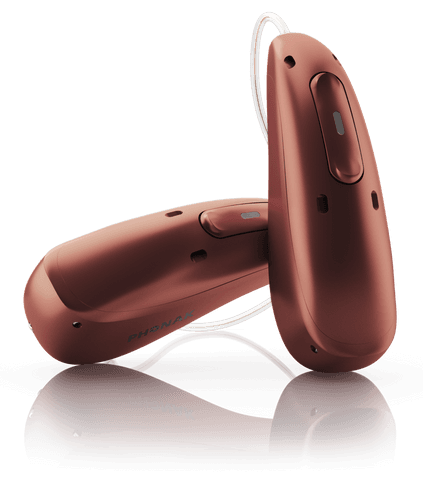
Phonak Audéo EON Sphere
Phonak

Phonak Audéo EON Sphere

In the ring

Spheric Speech Clarity 3.0 on the HYPERSONIC chip separates speech from background noise in real time, then rebuilds the acoustic scene with the speech enhanced.

A single large DNN for speech-in-noise. Phonak says HYPERSONIC delivers 25% more DNN processing than the DEEPSONIC chip in Infinio Sphere.

See our lab review
Oticon

Oticon Reveal 1 miniRITE

Recording in the lab

First hearing aid on Oticon's Sirius platform with a dual-AI design: Speech AI identifies and lifts voices while Context AI preserves the surrounding sounds that tell your brain where you are.

Two networks run side by side, one for speech and one for the scene, rather than the single DNN used in Oticon Intent.

The Technology

What DNN denoising actually does

For twenty years, hearing aids fought noise with directional microphones and band-by-band gain reduction: point forward, turn down the channels that look noisy. It helps with steady hum. It does very little when the "noise" is other people talking.

A deep neural network is trained on enormous libraries of speech mixed with real-world noise. Running on a dedicated chip inside the hearing aid, it estimates, many times a second, which parts of the incoming sound are speech and which are not, then rebuilds the signal with the speech lifted out of the mix. Every contender here claims a leap in speech-in-noise from exactly this idea. The battle tests whether your ears agree.

  • ClassicDirectional mics plus spectral noise reduction. Attenuates whole frequency bands; struggles with competing talkers.
  • NeuralA trained network separates speech from noise moment to moment, including voices you are not facing.
  • The catchAggressive separation can add artifacts or flatten the scene. That trade-off is what a blind test exposes.
Our Scientific Approach

How We Stage the Battle

Marketing decks all promise clearer speech in noise. We put every contender in the same room, the same noise, and the same ears, then hide the labels.

One Lab, One Manikin

Each hearing aid is worn by the same KEMAR acoustic manikin inside our 8-speaker array in a quiet, non-reverberant room. High-fidelity in-ear microphones capture exactly what a wearer would hear at the eardrum.

Real Noisy Scenes

Cafés, food courts, dinner parties, a busy street, a train station. We replay recorded soundscapes with one to three talkers at realistic positions and levels, the situations DNN noise reduction was built for.

Hidden Good & Bad Anchors

Every scene includes a clean "good" reference and a degraded "bad" reference, unlabeled, alongside the contenders. Anchors pin the ends of the scale so every listener's ratings mean the same thing.

Recording Methodology

Fair Fights, Repeatable Recordings

Every contender is programmed for the same standard moderate sloping hearing loss (N3 configuration) and recorded in two configurations. Each battle session randomly uses one of them:

  • Initial Fit:The manufacturer's first-fit settings after basic setup, representing the out-of-box experience.
  • Tuned Fit: Settings adjusted to prescriptive targets for quiet and loud inputs, representing a professionally fitted device.

Both fits leave the hearing aid in its automatic program, so each brand's AI noise processing engages the way it would in the real world. Recordings are processed for headphone playback with diffuse-field equalization to remove the manikin's own acoustics.

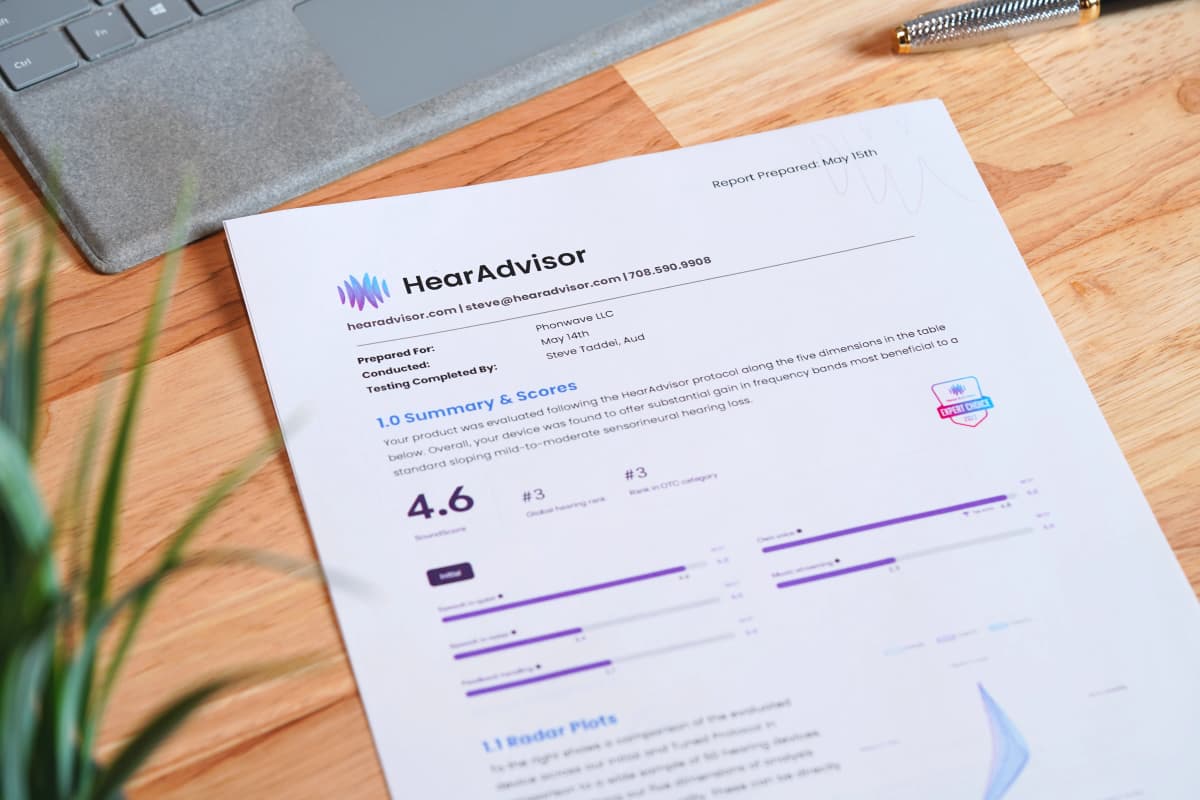
HearAdvisor detailed performance report
Really HardHardModerateEasyReally Easy
01234
Scoring

How a Winner Is Crowned

In every scene you rate each hidden sample on one question: how easy is it to understand the conversation? The 0 to 4 scale runs from Really Hard to Really Easy, and the anchors show you what the ends sound like.

After each round of three scenes we average every contender's ratings, reveal the names, and rank them. Keep going and the standings update scene by scene, with a per-scene breakdown so you can see which AI holds up in a café but falls apart at a dinner party.