HearingAssist Eaze vs MDHearing VoltMax
Side-by-side HearAdvisor lab results with SoundGrades, expert pick badges, and the same visualizations we use in product reviews.
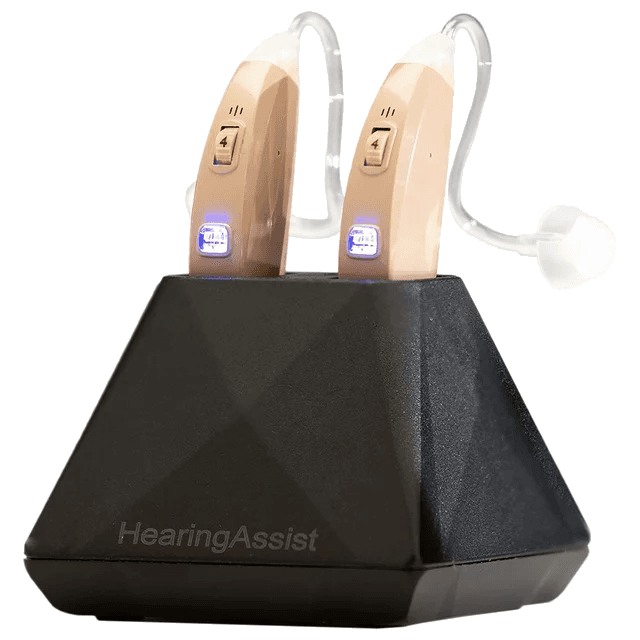
HearingAssist Eaze
The HearingAssist Eaze is a budget-priced OTC hearing aid that earned a B grade with a SoundScore of 3.4/5 in our lab testing. At $399, it positions itself as an affordable behind-the-ear option in the crowded OTC market, ranking #43 of 65 OTC hearing aids tested. In our testing, the Eaze showed mixed results across performance categories. Its standout strength is excellent feedback handling, scoring a perfect 5.0/5—0.46 points above the category average. This means users can expect stable performance without whistling during typical daily activities. However, speech performance is a weakness: speech in quiet scored 2.6/5 (0.20 points below average) and speech in noise scored just 1.3/5 (also 0.20 points below average), which may limit benefit in challenging listening environments. The most significant limitation is music streaming, which scored 0.0/5—nearly 2 points below the category average of 1.92/5. Consumers who prioritize streaming audio from their phones should consider alternatives. Own-voice comfort also scored below average at 2.2/5, which may affect how natural users sound to themselves. At this price point, buyers have several higher-scoring alternatives to consider, including the Elehear Beyond (4.34/5) and Apple AirPods Pro 2 (4.04/5). The Eaze may suit budget-conscious consumers who prioritize feedback-free wear over streaming capability and don't frequently encounter noisy environments.
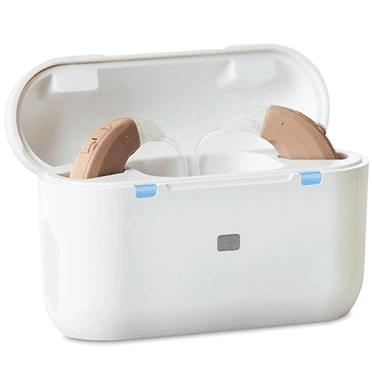
MDHearing VoltMax
The MDHearing VoltMax is a behind-the-ear OTC hearing aid priced at $699, earning a B grade with a SoundScore of 3.0/5 in our lab testing. This places it in the lower tier of the OTC hearing aid category, ranking 62nd out of 65 devices tested. In our testing, the VoltMax delivered mixed results across key performance areas. Its standout strength is excellent feedback handling, scoring a perfect 5.0/5—above the category average by 0.46 points. This means users can expect stable performance without whistling or squealing during typical daily activities. However, speech clarity proved challenging, with speech-in-quiet scoring 1.9/5 (0.93 points below category average) and speech-in-noise at 1.0/5 (0.48 points below average). Own-voice comfort measured 2.4/5, slightly below the category norm. A significant limitation is music streaming, which scored 0.0/5—nearly 2 points below the category average. Users who prioritize phone streaming for calls or media should consider alternatives. The device features rechargeable batteries, offering convenience over disposable options. At this price point, several competitors deliver substantially stronger overall performance. The VoltMax may appeal to budget-conscious consumers who primarily need basic amplification with reliable feedback control and don't require streaming capabilities. Those seeking better speech clarity or music streaming should explore higher-scoring options in this price range.
Performance metrics
Scale 1-5 (Tuned)
Lab metric by fit
Scale 1-5 (Tuned)
Speech level
Adjust input dB (Tuned)
Amplification (REIG)
Insertion gain at 65 dB (Tuned)
Audio scenes
Recorded samples (Tuned)
Fitting configuration for tuned fit