Orka Two vs Otofonix Groove
Side-by-side HearAdvisor lab results with SoundGrades, expert pick badges, and the same visualizations we use in product reviews.

Choice
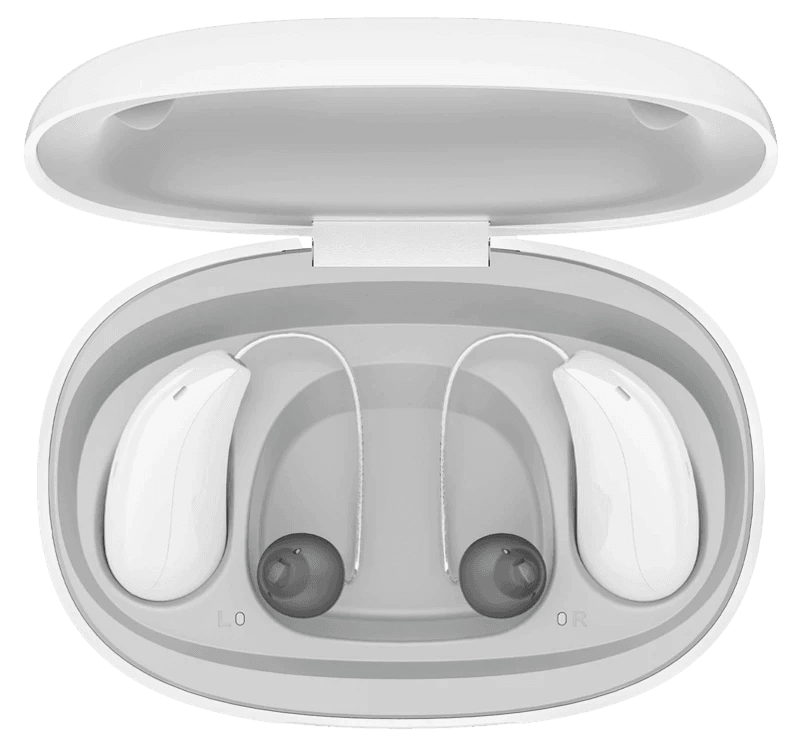
Orka Two
The Orka Two is a behind-the-ear prescription hearing aid priced at $1,899, earning an A grade with a SoundScore of 4.0/5 in our lab testing. It ranks #27 of 39 devices in the Prescription Hearing Aid category, placing it in the top 67% of its class. In our testing, the Orka Two demonstrates notable strengths in several areas. Speech in quiet environments scores a solid 3.7/5, measuring 0.32 points above the category average. Music streaming quality also performs well at 3.3/5, sitting 0.54 points above average—a plus for users who frequently stream audio from their phones. Own-voice comfort scores 3.2/5, which is 0.50 points above the category norm, and feedback handling is excellent at a perfect 5.0/5. The device's most significant limitation is speech understanding in noisy environments, where it scores 1.4/5—a low result that falls 0.71 points below the category average. This weakness may impact users who frequently encounter challenging listening situations like busy restaurants or social gatherings. The Orka Two includes Bluetooth streaming for both iPhone and Android devices, hands-free calling capability, and rechargeable batteries. While it delivers solid overall performance for its price tier, shoppers comparing options in this range should note that some competitors like the Rexton Reach R-Li T80 at Costco achieve higher overall scores. The Orka Two is best suited for users who prioritize quiet conversation clarity, streaming quality, and comfort, and who encounter noisy environments less frequently.
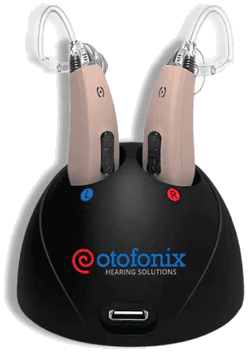
Otofonix Groove
The Otofonix Groove is a behind-the-ear prescription hearing aid priced at $795, earning a C grade with a SoundScore of 2.7/5 in our lab testing. This rechargeable BTE ranks #38 of 39 devices in the prescription hearing aid category, placing it in the bottom 5% of its class. In our testing, the Groove demonstrated excellent feedback handling at 5.0/5, scoring 0.28 points above the category average. This represents a genuine strength, with the device maintaining stability during our standardized challenge motions. However, speech performance was significantly limited, with speech in quiet scoring 1.0/5 (2.40 points below the category average of 3.40) and speech in noise also at 1.0/5 (1.11 points below average). Music streaming was not functional in our tests, scoring 0.0/5 against a category average of 2.76. Own-voice comfort also fell well below typical prescription hearing aid performance at 0.4/5, which is 2.30 points below the category average. At this price point, several lower-cost alternatives delivered stronger overall performance in our testing. Consumers seeking value in the prescription category may want to explore other options, though those requiring robust feedback control in a rechargeable BTE format may find the Groove's stability noteworthy despite its other limitations.
Performance metrics
Scale 1-5 (Tuned)
Lab metric by fit
Scale 1-5 (Tuned)
Speech level
Adjust input dB (Tuned)
Amplification (REIG)
Insertion gain at 65 dB (Tuned)
Audio scenes
Recorded samples (Tuned)
Fitting configuration for tuned fit