Perceptual Sound Quality
Overview
To evaluate sound quality we use a perceptual model designed to estimate the sound quality impacts of linear spectral distortions, based on data from Moore & Tan (2003)[8] modeled in Moore & Tan (2004)[9].
This model is appropriate because passive earplugs act as linear filters. It may not be appropriate for active earplugs with nonlinear processing.
Computing the Distortion Metric D
We compute the metric D as described by Tan and Moore (2004)[9] using the "Final" free parameters (their Table 1, right column) that had the highest correlation to human judgments of both speech and music sound quality.
Procedure
- Loudness equalization: Both the open ear and earplug-inserted recordings are scaled to the same loudness (100 Phons)
- Excitation patterns: Cochlear excitation patterns are computed for each signal using the
moore1997model in the Auditory Models Toolbox[10], modified to apply the filter sharpening parameter () - Floor application: A floor ( dB) is applied to both excitation patterns
- Difference computation:
- First order: Signed difference of magnitude between open and earplug-inserted patterns
- Second order: Signed difference of local slope
- Frequency weighting: Differences are multiplied by a frequency weighting function using the fitted free parameter ()
- Combination: Standard deviations of first- and second-order differences are computed separately and combined using the final free parameter ()
The resulting value D has a strong negative curvilinear correlation with human judgements of sound quality.
Transforming D to Predicted Quality
We transform D to have a linear and positively-correlated relationship to perceptual judgements using a second-order polynomial fitted to the data from Moore & Tan (2004)[9]:
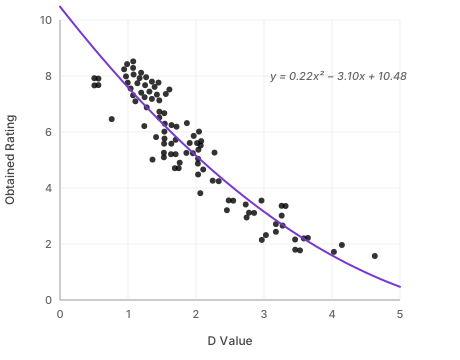
Figure 2. Mapping D to Sound Quality. Data points replotted from Moore & Tan (2003). Polynomial fitted to these data is shown and used to transform D to estimate average rating.
This transforms D to a scale where 1 is worst quality and predicted quality increases linearly up to 10.
Mapping to 0--5 Scale
As with the loudness reduction metric, values are computed separately for each of the 10 earplug insertions and the median is taken. Scores are normalized by the highest observed score (7.2) in our initial set of 24 earplug conditions and scaled:
- 0 = worst quality
- 5 = best quality
If a future earplug exceeds the normalization anchor, its score would exceed 5.0. In this case, we would update the anchor and re-normalize all scores.