Laboratory Setup
Room and Equipment
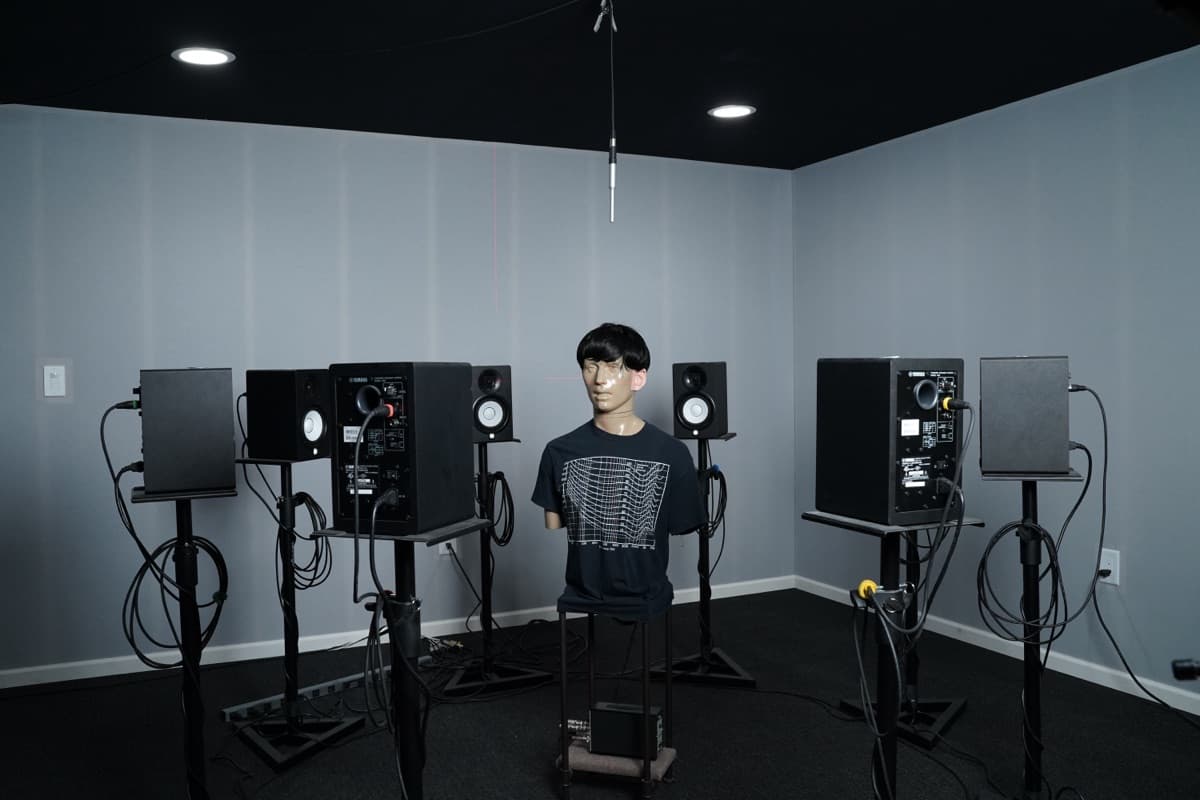
We designed and built an acoustic testing laboratory (Figure 1) that was sufficiently quiet and non-reverberant for our tests. The walls and ceiling were filled with sound-absorbing material between studs (RockWool Safe 'n Sound Insulation or heavy blankets) and the floor was carpeted.
The resulting space had the following properties:
| Parameter | Value |
|---|---|
| Ambient sound pressure level | 35.7 dB LAeq (A-weighted) |
| 4-frequency average RT60 (0.5, 1, 2, 4 kHz) | 0.059 s |
| Estimated critical distance | 1.3 m |
We used the reverberation time and room volume to estimate the critical distance (the distance at which the direct and reverberant signals have equal levels)[1].
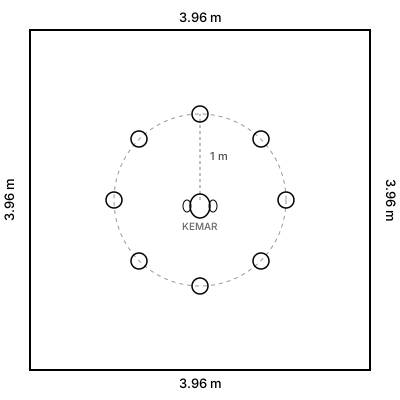
Figure 1. Test lab floorplan (3.96 m x 3.96 m room with 8-speaker ring)
We installed a ring of 8 speakers (Yamaha HS5) with a radius of 1 m -- thus ensuring that at the center of the ring the direct sound from the speakers dominates any room reverberation. Each speaker is equalized to be flat ( 2 dB) from 50 to 15,000 Hz.
We placed an acoustic manikin (KEMAR 45BA) in the center of the speaker ring. The height of its artificial pinnae was aligned with the high-frequency drivers (tweeter) of the speakers. The manikin has:
- GRAS KB5000/KB5001 Artificial Pinnae
- GRAS RA0401 High-Frequency Ear Simulators
- A wig
- Internal cavity filled with sand (for high SPL testing of earplugs)
Our coupler mics (Standard IEC 60318-4, 711 coupler: GRAS RA0401 High-Frequency Ear Simulator) are fed to a high quality digital audio interface (Antelope Orion Studio).